Death Angels – Understudied?

Death Angels have obviously been a common tool at work since the time of the Magistrate, and remain as such now that their design has been put to use by Reven. Yet despite the fact of their commonality, there is a lack of wide-spread counter measures against them. This is a fact I quickly discovered after trying to further investigate our encounter with the Agamemnon. At an off-hand glance one might consider this a by-product of their design. In combat, despite their lack of direct defenses, they are supremely quick and maneuverable to compensate. On top of that, when dispersed, their systems continue to function on an individual basis, making it appear as they have no inherent weakness and must simply be battered through thoroughly.

But I would quickly beg that is not the case. The unfortunate truth of any design is simple – the amount of resources per unit determines the true cap of its potential, and the Death Angel as an individual is a very economically friendly design. A Death Angel is no supernatural entity, no forever-acting zombie despite the pieces you shred it into. A glance into the schematics reveals the larger system. The DA’s calculate off a common hive-minded function that responds accordingly to their remaining pieces. An unharmed DA can function off the notions set about to its entirety, while a piece torn asunder from its torso still carries an embedded chip set that – when separated – carries on its functions in its new form of individuality. This very system is what runs an entire swarm of DA’s under a common set of hive-oriented goals. The design is genius in its level of abstraction and adaptation per unit size.

But the genius behind the design does not compensate for the lack of resources per unit, it simply changes the way you approach the problem. As mentioned, each individual joint-section carries an embedded system responsible for the calculated control of its subset. Therefore, immediate tactics are obvious. Rather than seeking dislocation, a combatant seeks whole destruction. Rather than dismembering a joint, one focuses on blunting bulk pieces altogether. Rather than ripping through minor systems with a flush of heavy-penetration rounds, one can seek to use explosive measures to rip apart larger sections as a whole. But there in lies the problem, no?

The very nature of explosive force, be it through literal blunting or the use of detonation, implies a disadvantage of pace. A missile is slower than a bullet, a mace is bulkier than a blade, etc. And so the design of the DA would seem to counter-act the weakness of its physical vulnerability through its use of speed and avoidance. But in reality this is no counter-action, it is a pure reliance. And there in lies the focus of the real issue. How does one go about ‘slowing down’ a Death Angel, all the while taking as many precautions as possible to keep it in one larger more manageable piece and not overwhelming yourself by separating its sub-systems?

The most versatile method of transportation for almost any offense is the simple bullet. As a matter of fact, my original thought was to test one of Ms. Ravess’ recent addition to our nano-assemblers, the cyro-round. Against most mechanized units, this is a fabulous tactic to try, but the Death Angels specifically make the round’s foothold rather difficult. Due to vibration caused through the sheer number of lesser joints on a DA’s body, points of pressure increase exponentially upon the freeze-forming process and don’t allow it a proper foundation not to shatter under. On top of that, in a spacial setting, such methods have little effect on the heat-intensive repulsor functions which give them their flight capabilities, minimizing their true mobility minimally at best. But the methodology itself is sound.

Thanks to the efforts of Captain Hemmingway we were able to brainstorm up another solution along similar lines. If one cannot settle for a method of complete block aid initially, why not a slow constrictive effect until ceasing operation? The entity in thought becomes a variant of a simple phenol formaldehyde resin. With a few additives, a phenol crystalline and a formaldehyde compound in a setting of heavy heat and pressure form up a very useful sticky resin. In this liquefied state, the resin is able to quickly penetrate even the deepest layers of joints before the introduced crosslinking agent (para formaldehyde, in this case) forms it into its hardened, solid state. Not only does this quickly constrict motions, but the resulting substance carries excellent heat-resistant properties as well as acting as an electrical nonconductor. This in turn can cause heat-sink like build up properties as well as mess with exposed wiring in joint sections to cause stronger malfunction. Even under the heavy heat of a repulsor this remains as a solid clogging agent.

Thanks to Ms. Ravess’ convenient design of the nano-assemblers in accordance with fitting rounds, I was able to scrounge up a test design for this concept. The outer shaft for a shell collapses inwards to the inner, more solidified space containing the reactants that in turn gain increased pressure upon impact, causing the resin to form. This resin will shift to its hardened state gradually as the crosslink settles, and mobility is lost thus. Areas of greatest effect are joints and repulsors themselves, but penetration into bulkier systems don’t cause much disadvantage either. With a DA’s mobility lessened, a combatant is more capable of destroying it in the proper form, through means of easier missile lock-and-follow or however they prefer.

Initial testing footage may be found here.
Filed under: Weaponry and Tools | Posted on April 13th, 2009 by Crono | No Comments »

Sion – What do we do?

Privately labeled for crew members only – this discussion is inaccessible outside of the ship unless I forward special permissions otherwise.

The situation as what we’ve gathered thus far is summed up easily. The planet is stuck in its perpetual warfare due to the antics of Alta’s new head Dr. Alden. The Divas were his original project, privileges taken away when his experimentation became inhumane, and in turn secretly created the Apostles as his means of revenge. Without going into details, he has managed to use this excuse of constant and pointless warfare to overturn the prior head of Alta, General Rozencratz, and now has him locked away. The public itself is seemingly ignorant, though that is understandable under the day-to-day conditions of affairs. So long as the Doctor continues to use the Apostles as a crisis-regulating tool he can continue to grip the public in a constant state of fear.

The discussion falls here: we’ve committed ourselves to action – but what do we do? Prudent facts are as follows.

  • General Rozencratz has been taken and is missing.
  • Dr. Alden is now the head of Alta.
  • The Blaze has agreed to work with the Void for purposes of preserving the planet and populace.
  • Void forces are under assault from native forces.
  • Local leyline are a complete frayed mess, and accelerating in their deterioration.
  • The clock is ticking until Reven resumes his more forceful method of fixing local leyline.

As I view of the issue thus far:

  • We will be working with Void settlement to help defend from their aggressors in the interest of a joint force against the troubles ahead.
  • Lucy is currently working with other specialists aboard on the thought of developing a wide-spread interruption measure to shut down large numbers of Apostles without having to sacrifice too much direct combat power. This will alleviate Void and Blaze forces thus.
  • Eleste is preparing a system for mass-propagation to the public for the right moment, so that the sweep through the current government can be swift and supported.
  • General Rozencratz needs to be retrieved. Yesterday’s operation has given us lead on where to begin.
  • Dr. Alden needs to be apprehended.

The order of these actions, however, becomes important in a situation such as this. If we propagate too early, it could result in two consequences, the first being a full-turn of panic on Dr. Alden’s part, in which case he might use the chaos to ‘take everyone down with him’, so to speak, shifting Alta’s forces in such a way that the city would be defenseless and spearhead the Apostles at them in return. The second worry becomes whether or the populace itself is stable upon overturn. If we were to simply propagate without proper measures taken and they succeed, we’ll be sitting with a state of anarchy, and another less-than-preferred opportunist might dare take the chance and we’ll be back at square one.

If the Doctor learns that his situation is becoming hopeless before we manage to apprehend him in any fashion, it is likely he’ll forward a request to kill the General while he is still in their custody if for no other reason than revenge. Usually I’d say this would be a bitter move even for the worst of men, and certainly not the first thing to cross their mind during the final moments, but this entire campaign was launched entirely on the basis of ‘revenge’, so I would not so quickly dismiss the thought here. If we make any move that endangers the General whatsoever, we become immediately disabled in our efforts to restore and hopeful semblance of order in the city even -if- we manage to remove the Doctor from his head. Thus my thoughts are drawn.

  1. Immediate goal: Relieve the Void’s forces. This may sound off, but if the Void continues to function poorly in the environment, we may loose the time we’ve been given, and we’re likely to be able to make use of their assistance elsewhere more efficiently when we’re not on a divided front.
  2. Find General Rozencratz. The longer he stays in the enemies custody, the more dangerous this operation becomes.
  3. Propagate at this stage. By assisting the Void we’ve assured proper resources to protect against any military threat, Alta or Apostle, against the populace.
  4. Assist the populace in the overture of Dr. Alden and use the opportunity to make our apprehension.
  5. Ensure proper foundation of General Rozencratz back to his prior role.

Each of these steps, I feel, must be taken into consideration. Even if we stop the war with the Apostles we do not ensure a stable environment suitable for leyline repair. And merely taking down Alden on his own down not ensure a full disruption of planetary hostility. We have to be thorough about our approach, and quick.

This is how I feel, but the point of this is open discussion. I’d like to use this space to collaberate on everyone’s thoughts once each individual has had time to consider what they’ve seen, heard, and believe to be the best course of action without being in the immediate fray of biased emotion.

Filed under: Local Read Only (Private) | Posted on April 6th, 2009 by Crono | No Comments »

Breaking the final wall – Risk vs Gain?

Before I begin, I’d like to comment that this is a required upload to any Marshalship vessel with a CTI representative aboard.

The field of simulation has been of a focal point for the CoRe and Marshalship both since its origins. The reasons almost go without saying – the ability to test and try any number of scenarios for any number of reasons over and over without physical repercussions or even physical limitations has spurt our productivity rate in every field many fold. In truth, however, there are problems which our current setup cannot solve and never will be able to without modification. That problem is the fact that a simulation is just that – an accepted facade. No matter how we try to immerse ourselves in such an environment, most circumstances will not allow us to ‘truly’ fall into the moment.

That is now the subject of research at hand. The human (or simply sentient) psyche is a delicate and fragile entity that even today is hard to explain and alter.  Trying to do so carelessly has caused irreparable damage to the subject at hand countless times in the past. But the fact cannot be ignored – should we not seek to understand this topic? Should we not seek to better understand ourselves? This is especially prudent in times of conflict and battle. How many times have lives been lost simply due to the shock surrounding the subject of life and death?

Records can answer for that. In a random sampling of recorded wartime conflicts from twenty members of the CoRe prior to their actual joining, it was found that nearly 5% of all soldiers, when put into real combat, ceased to function accordingly. Of course, that is a description and a number, what does that mean really? It was set under a strict set of criterion – when shots were fired, so to speak, something snapped. This could include the sudden realization that one did not have the emotion necessary to take a human life, the focus necessary to concentrate and function under the pressure of combat, or even the inability to maintain one’s self in the environment of allies – friends – constantly falling around you. Such surveys and records cannot even hope to be fully aware of the records and accounts shown and told, either, so the count is likely to be higher than lower. What this means is that, due to improper awareness of ones of mental capacity, 5% or more of all soldiers are sent out to die without even giving a fighting effort for their causes.

And so comes this recent simulation research. I will not describe the methodology or technology, that is not my duty. All I have been required to say is that research has been funded and is well into alpha testing of what I am about to describe. The setup, put simply, seeks to alter the subjects memories as their physical form is put into stasis upon simulation activation. It offers a very clouded explanation to the mind that roughly mimics memory, filling in only the gaps that the brain actually asks for or tries to resolve. This in turn makes the simulation real, from the subjects perspective. The setting, the reason they are there, the history which brought them there all makes an attempt to fall into place and feel naturally explained. And so the simulation of reality is created – the final wall of self-awareness is brought down.

The flaw of the system is obvious. When the program is ended, the algorithm attempts to backtrack itself, offering a simulated explanation for the new memories the subject, or subjects, just experienced. “Just kidding, it was practice!” The brain is more accepting of lies than explanations, though. The ending is the piece which causes true problems in the system.

First, simulation or not, trauma becomes real. It is easily possible that subjects will be placed in trauma that would never happen to them in real life. Even when the simulation ends, and is explained as a falsehood, that shock is not guaranteed to go away. It can also lead to complications both inside and outside the environment – that is, an individuals ability to disbelieve. Prolonged exposure on alpha subjects has led to a couple cases where the subject beings questioning their own existence, whats a simulation, and whats not. That is, the begin to accept the idea that ‘that was just a test simulation’ that they start questioning when they might roll out of their bed one morning only to ask themselves if they are in a simulation at that very moment. Those subjects have, of course, been pulled from the program and are undergoing extensive therapy.

Which leads me to my own statement. As required, I’m forwarding this to my database here so any and all interested can see. However, I am not required to allow access or seek any research on these files. And I plan on doing neither. Until this technology can prove itself beneficial without risk of harm, I will be keeping it sealed in my personal file until it is updated thus. If you do wish for more information, however, I will be happy to forward to the proper representatives.

-Crono Arinborn

Filed under: Simulation Manipulations | Posted on March 28th, 2009 by Crono | 3 Comments »

C.T.I. Representative Apology

FORCED UPLOAD ON DOMAIN SPACE: RANK B* OVERRIDE REQUIRED

To those in attendance of the CoRe Reception last evening,

I’m writing to offer my deepest apologies to those who were present for the wild misinterpretation and presentation by one Crono Arinborn on my behalf. We are not here to spend our funding on artwork or fancy music. Our direct focus is on technology both feasible for use by both the CoRe and Marshalship in furthering our presence and ideals across the multiverse. Mr. Arinborn, vastly under prepared for his presentation, did show the capabilities of the system but completely failed to point out its relevance from our standing. The technology, as mentioned, is little more than a simulation interface which takes the raw data straight from the psyche without parsing or modification, and simply transmits it to an audio channel in real time. With this real time addition to the system, rather than force-loading via file or memory input, the tool can be expanded for much greater purposes. Think of the possibilities of a trained ‘imaginist’ creating false communication requests on the fly when we’ve managed to intercept our enemies messages, or frauding live communication via comm link, or any such scenario. Surely this is a technology worthy of field installment and further supporting.

As for Mr. Arinborn proper reprimands are being taken. Considerations have been taken not only for his failure to properly describe the perks of this project but also for his blatant disregard for the upstanding class of whom he was presenting for with his  poor choice of performance (record of  generated sound output) in light of the presence of the a proper orchestra. Again, apologies for the haphazard waste of time. Specifically I would like to apologize to the crew of the Blaze of Glory. One can only imagine what incidents have occurred due to such lack of proper planning and self restraint. I will be seeking to replace him aboard the vessel with a real representative with haste.

-Dr. Marcus Kline, C.T.I. Communications Developement

Filed under: General | Posted on March 22nd, 2009 by Dr. Kline | 2 Comments »

Simplifying Contributions – Mech Interface

At the pace of current conflicts, I don’t think it sounds pessimistic to point out that resources are surprisingly strained. This is most notable in the labor division – the trouble with pulling recruitment from refugees of other worlds is a simple one. Due to the fact that Verorox is a combination of technologies from dimensions spread far and wide, it becomes a strained process ensuring equal knowledge and training on any particular end regardless of what it is the individual seeks. A soldier is particularly hard set these days if he has no prior training, as his task is to be instantaneous relief, but in order to be effective, he has to have a at least a basic set of skills to be anything more than a hindrance. Thus comes the setup for one of my current projects .

We live in an age where technology can not only teach us, but often time make up for our lack of experience while we do so. A standard mechanized armor unit is an incredibly powerful tool depending on both the model and the pilot. Converting ourselves into gigantic, metallic covered muscle, as a metaphor, allows us to do so so much. The trouble within, however, comes from the experience necessary to pilot such a craft effectively. Trying to translate human controls to a series of levers, buttons, pedals and the like is far more difficult than say, a car or boat or something with just a two-dimensional plain of thrust and direction, and the argument could even be made for aerial craft.

So I made a simple observation – one that has in fact been made before, but has often been made on a personal, expert level. Most standard mechanoids are, in fact, just shaped as humanoids might be. Why must our movements and input be so drastic from this basic setup? There have been several instances of extremely customized interfaces for very mobile mechanoids to react directly to the input of their specific pilot, that is, that person’s bodily motion. To repeat this process for every would-be pilot, however, would be even more costly in both time and resources than our current pilot programs. But we are not seeking to outfit every pilot with something extremely customized. For most Marshalship Cadets or First Rank we are in fact simply trying to offer a mass-produced system for the average soldier. We need to create a basic skeletal interface for a generic mechanoid model that will allow a newly recruited soldiers to, quite simply, jump right in and join the fray.

But that request is exactly what makes this problem so EASY. That problem has already been solved a long time ago, by none other than 3D environment modelers. The problem came about when trying to figure an efficient means of colliding a physique to a polygon mesh. It was an extremely tedious and costly process to retrofit a working physique to a set of arbitrary polygons every time one created a new 3D model. The solution devised was thus. You’ll have to pardon my rough simulation.

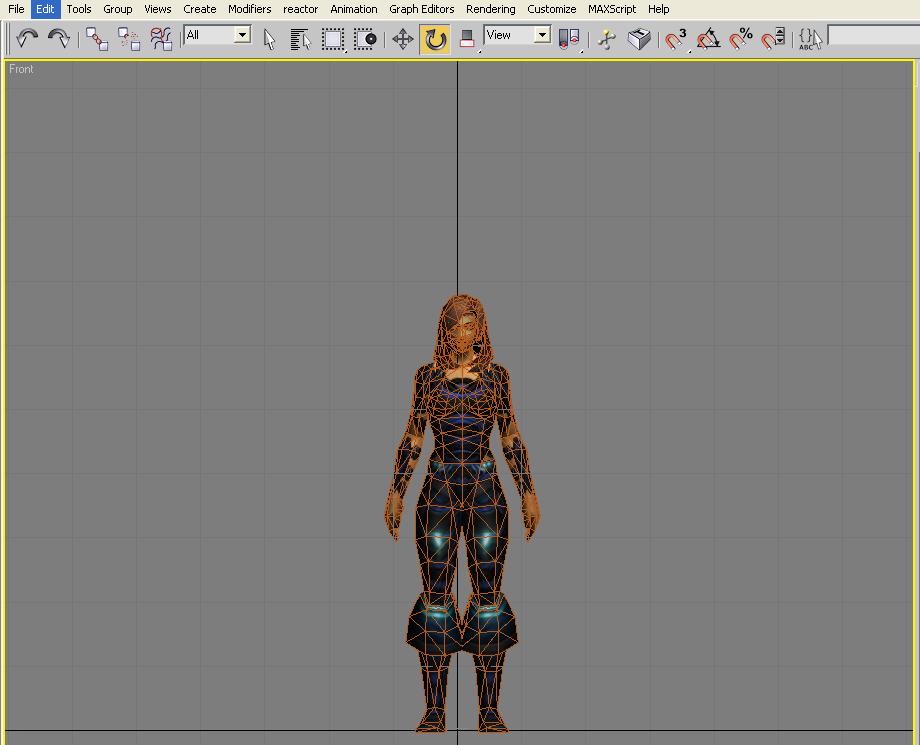
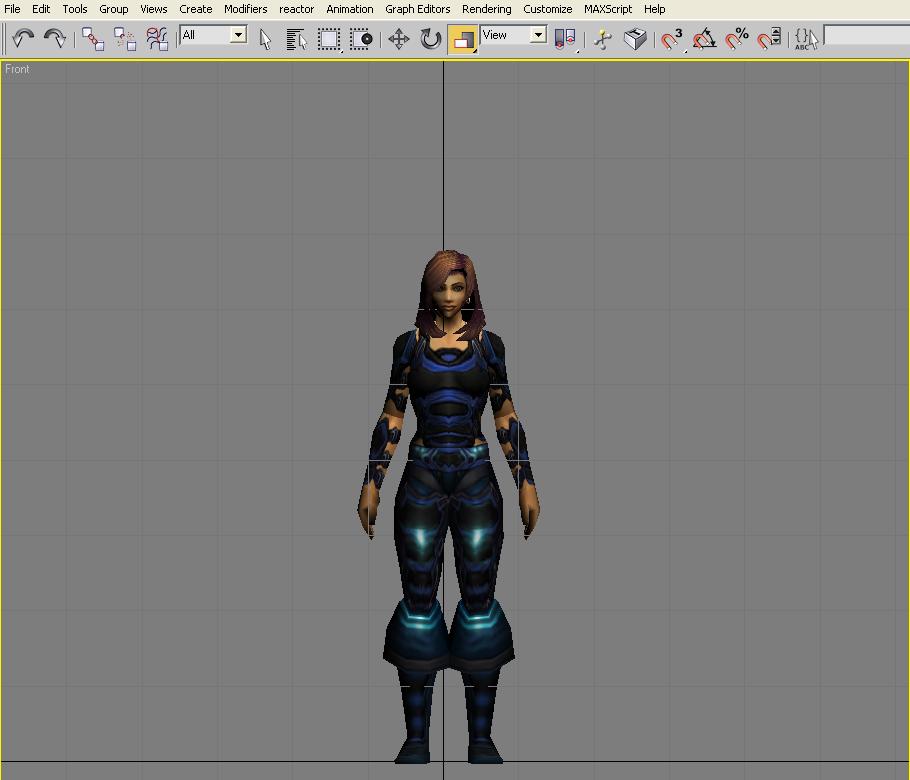
First step, create your object mesh.

The mesh is thus outlined in a series of vertexes representing the breakdown of individuals two dimensional plains, polygons simply.

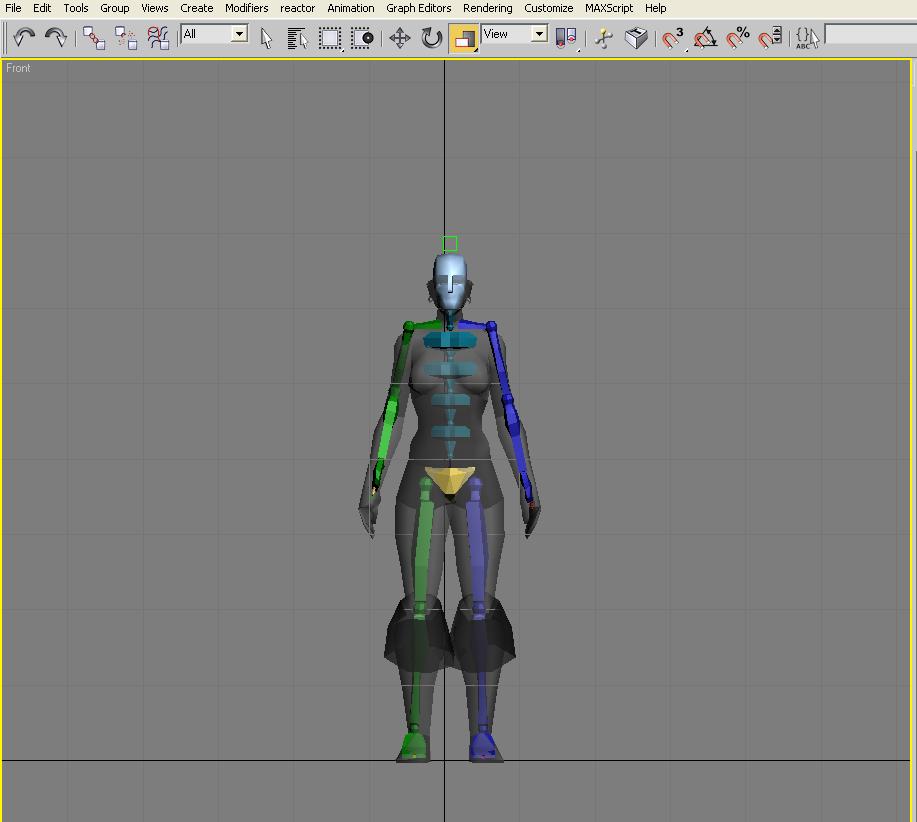
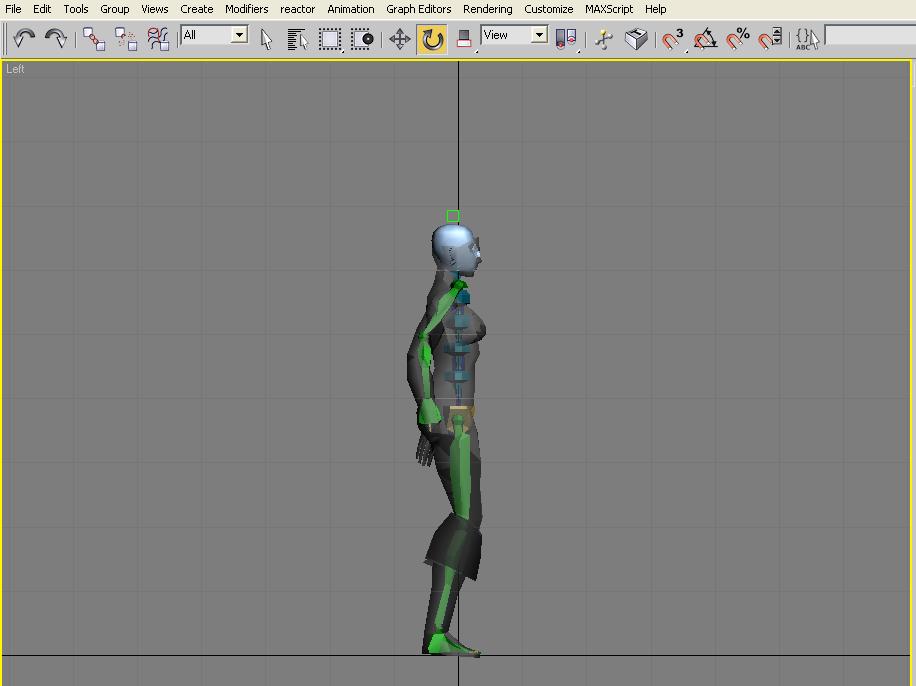
Next a generic object representing a skeletal structure is overlapped with this mesh. This skeletal structure is also referred to as a biped.

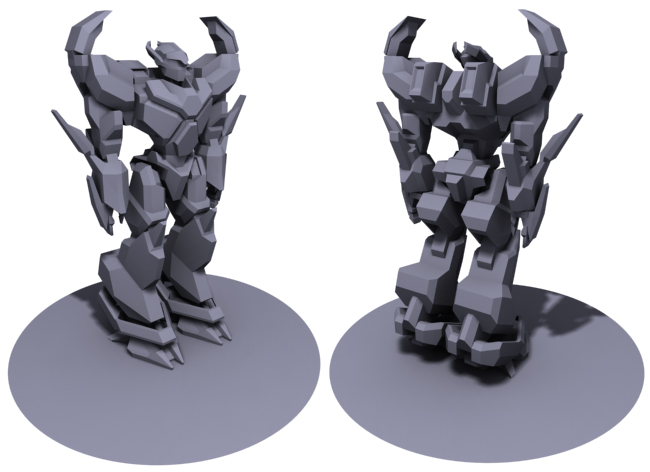
Now, with the proper fitting, a physique representing this bone structure can be automatically generated. Each vertex of the polygon mesh can then be attached to belong to a specific portion of this physique, and when the bone structure is animated, will follow in suit depending upon that vertex’s specific settings. The common settings are whether or not the vertex is deformable, stretching the length of its edge with surrounding vertexes, or not . This is where my observation comes in. Simply put, a standard design mechanoid is nothing more than a set of metallic polygons, all of whose vertexes could be represented as non-deformable. A setup like the following could then be easily generated.

The final interface would only need be the following process.

  • Convert the physical form of a mechanoid to a simulated mesh, similar to above.
  • Create a generic biped suit, a few different sizes and stretchable fits for average pilot builds.
  • Run the physique generation process on this biped to connect it to the mesh. Now any actions made by a pilot who fits this suit will be translatable to the mesh.
  • Forward simulated coordinate changes of the mesh to the physical unit itself.

You now carry a system capable of mimicking human motion. Obviously, the common build of mechanoid for field combat or cultivation is nowhere near as quick or capable as the human body. But this process drastically reduces the necessity for immediate pilot training upon recruitment. Rather than the standard length of course, it could easily be retrofitted to a couple hour course detailing the methods of keeping your movements ‘stiff’ so as to try to remain somewhat non-deforming as the mech itself, as well as learning to interact with the H.U.D. displaying current parameters of speed and vector limitations of the unit itself. Certainly, pilot instructions for proper units should still be an eventual requirement for those planning to remain specifically within that field, but this broadens the perspective choice of bulk pilots in emergency situations.

Perhaps the best initial use of this system will not even be for combat, but will become a tool for cultivators being sent out to the recently proposed list of planets to be colonized and used for further resources. I’ll be looking to forward this proposal to the CoRe advisory council once I’ve gotten the proper proof and credentials. If any engineers aboard would be interested in helping me create a prototype mechanoid, I can focus on finalizing the forwarding interfaces, and we can get the schematics ready for generic use by the time the workers are ready to make their move. Please contact me immediately!

-Crono

Filed under: Weaponry and Tools | Posted on March 20th, 2009 by Crono | 4 Comments »

Silenced Communication

It would be an obvious statement to say that communication is the key to a functional unit of any kind, inclusive of combatants. It is not so obvious, however, as to what the best means of communication are, as that rapidly varies depending on the situation. Text, speech, and bodily motion are all viable candidates under the right constraints.

From the case studies I’ve reviewed so far, communication has never caused a particular disadvantage to our group except under a few key conditions. The main condition is that, when a smaller group is forced to coordinate against a single, more powerful enemy, the enemy is often able to intercept communication and judge it accordingly quicker than an entire unit can respond to a verbal command. The enemy is, after all, but one mind that needs to react. Most notably among these encounters would obviously be our most recent simulation against Reven. During the heat of combat, it can be difficult to keep a voice low, especially if you’re trying to transmit it over a comm link given proper interference while still trying to remain audible to friendlies alone.  As such, I’ve been trying to derive a solution to this issue.

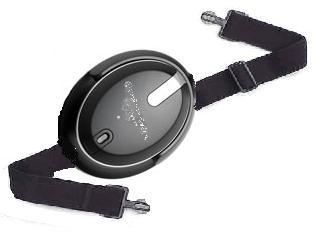
What I’ve come up with as a beta model is this little toy.

noise_cancelling_mic

The premise is neither impressive nor new, but adaptive. It is a simple mouth piece that is designed quite similarly to,  say, a set of noise canceling headphones. In reverse however it is applied as a… noise canceling microphone, so to speak. A strap is applied over the mouth with the protective covering, preventing any sound from escaping, with the inside microphone linking directly to the standard comm system. The only feasible way it could be intercepted is by cracking the channel or having a physical comm link compromised. I’ll be performing a few simulations today while wearing the base model to see how it upholds and performs, as well as to spot any other basic issues.

UPDATE:

Well, after the day I’ve realized that this device is indeed need of work. The concept works great on paper, but I had a few initial oversights.

  • First off, my base model has two pins and no cinch on the strap. I was forced to improvise placement for the day.
  • Negotiating a balance between proper constraint of attachment to comfort ratio will be tricky, but can likely be solved with a sleeker, better designed model.
  • An average combat, as their adrenaline rushes and their body begins to work harder, will cease to breath from their nose and instead breath from their mouth. This device prevents that entirely, though can always be removed/replaced with a simple tug, but I’d like to find a better solution.

So far I think the idea is dead on, but the method used could use some tinkering. Rather than a full bulky mouth cover, I’m going to try and do some research on the possibilities of creating a smaller piece that emits a very small noise-dampening field around the user’s mouth area. The trouble there, however, becomes microphone placement such that possible noise pick up is not simply dampened away before reaching the microphone. The other thought would be to create a much larger apparatus, such as a pilot’s headgear that allows for both radio communication provided with an air tube, but this sacrifices convenience and mobility. This is starting to become more of an engineering problem from here. If any technicians aboard would be interested in helping theorize or create a solution, I’d be more than grateful. Feel free to contact me.

-Crono

Filed under: Weaponry and Tools | Posted on March 19th, 2009 by Crono | 1 Comment »

Ability vs Tactics – Ego Seperation

The MM-Bot has been completed and is fully operational, but has left a stale taste in my mouth. The truth of the matter is that the simulator has one of two harsh limitations. Simple simulation droids loaded with MM still get quickly overwhelmed through shear ability of many combatants on this ship, making the formulation seem a pointless waste of computation time. Difficult programs however are only difficult due to overwhelming abilities. An observation, simply put, is that ‘ability’ is something that is equally as hard as ‘tactics’ to simulate. There is a fine line between something that you learn nothing from due to simplicity, as well as something you learn nothing from due to unrealistic circumstances. What is needed, in truth, is real combatants.

Of course, as you all know, the simulator can draw figments of combatants from memory and create a surprisingly realistic experience. This comes from the fact that both ability and mindset are encompassed into one simulation of an entity – it is a simulation of the person or being. But something like the MM-Bot algorithm can’t simply be jousted into a person – over a simulation, it wouldn’t react at all. MM-Bot is, after all, a tactics interface.

Lets take an example, say myself.

My list of ‘abilities’ might include: Ability to swing a sword, throw a punch, hold a position firmly, etc.

In turn, my list of basic tactics and ego might include: Defensive while analytical, frantic when confident, careless when prideful, tend to attack from the left. Or some such.

And thus, the goal state is to replace that list of human ego with the mini-max bot’s algorithm, which clarifies the problem. We need a system whose parameters are a fully functional simulation of a person, and outputs two separate interfaces – a blank bot who only carries ability, and a personality file for tactics and ego.

This has been the leading basis for my research last week – via a brute force exhaustion method with a few inference variables. The process must be human lead, which makes it a little tedious, but the results I’ve had thus far using myself as a test subject have been more than worth the efforts.

The first step is to load a full simulation of a person or combatant. Engage in conflict. Then, upon the interactor’s judgement, the system is paused and snapshotted by calling an application “Freeze Frame” I added to the database. This Freeze Frame is a snapshot of scenario and system resource usage, essentially allowing insight into what the currently loaded character is activating in its own code. The system should be frozen in a few key points. One snap of regular, uninhibited combat, and one for as many different ’emotions’ at the interactor can draw out – when the character is humiliated, angered, grieved, saddened, pained, etc.

The final step is an intersection seperation which opens all system usage Freeze Frames, cross-referencing the methods called by the character during spurts of emotion, drawing them out. By referencing several different frames, counters ticking can analyze these resources. Once categorized, they are then fully seperated into the two seperate files of the character – ability and persona.

And tada! Now, by loading an ability-only bot, one can choose to open the archives of whatever personas are available. Many of the systems current interfaces for training work, as well as newly created interfaces such as my MM-Bot. On top of that, if lead through more crew members, we could get some very interesting interaction. For example, you could load your tactics into my ability set, or my tactics into your ability set, etc.

Think of the possibilities for self-improvement! Now that I’m nearly finished, every crew member will be able to lead through their own seperation process, and load themselves with the Minimax Bot and therefore fight an unbiased version of themselves that will constantly be looking out the outcome of its actions 10 cycles into the future. We’ll be able to get some foresight into our rash actions of prideful decisions.

Filed under: Simulation Manipulations | Posted on March 14th, 2009 by Crono | No Comments »

Requests

Please feel free to use this space to make requests of the technicians, engineers, and innovators onboard the ship. I can’t promise we’ll get to all of them, nor that all of them are even pheasible, but I’ll try to personally see to it that each one receives at least some note or consideration. This can range from anything from ideas for new weaponry or tools, to simply improving life on the ship. As requests are added and addressed, I will update them here.

-Crono Arinborn

Filed under: General | Posted on March 8th, 2009 by Crono | No Comments »

Endothermic Reactions – The Freeze Kit

I’m sure many of you have seen an ice pack before. A simple and harmless device, yes? By cracking a tube containing ammonium nitrate (NH4)(NO3) within a pack of nothing more than water, an endothermic reaction occurs in which heat is drawn from the reactants and is released, making the pack itself ‘cold’ or ‘icy’. Endothermic reactions provide us with this basis – a method for drawing heat out from substances, and this is an often overlooked tool. Often we link destruction through more conventional forms, explosions and gunfire, effects that use force to get their job done. But this in truth is perhaps the least efficient way we can go about the process of destruction.

Rather than waste our strength creating force, why not use a bit of intuition to reduce the force necessary? A large subset of substances, when chilled, become weak and brittle in their molecular bonds – energy itself is being removed after all, so why wouldn’t that be case? Thus is the inspiration for my current idea – the Freeze Kit.

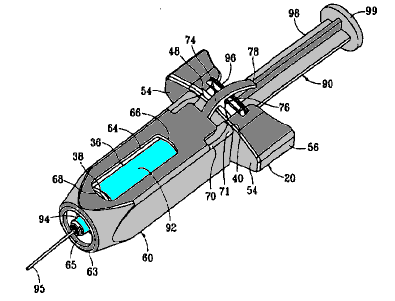
The kit itself will be little more than a thin though sturdy syringe linked to three tubes. One carries an offset of prior mentioned ammonium nitrate in a highly condensed form, the other, high-pressured hydrogen. By jamming the syringe into something confined – a small crack, the hinge of a door, a lock, anything of the sort, and then ‘injecting’ the solution, the reaction is allowed spark to life. The way the tube system is set up forces the hydrogen to react first upon air, pressured in a way to condense into water over the surface of the injection, which then meets with the ammonium nitrate. The  final tube is a little something I added to manipulate the strength of the reaction, causing it to manifest at a much stronger rate than… well, than an ice pack. The result is a near instantaneous drain of heat from the subject of injection, causing, as mentioned, an unstable and brittle effect.

So what are the uses of such a kit, you ask? Pending size and strength of a particular kit, this could be used to cause otherwise impenetrable walls to become ram-able, to have gates removed from their hinges as they shatter, or even something as subtle as cracking a locking mechanism with little more than the faint sound akin to cracking ice rather than breaking down a barrier itself, keeping ourselves quiet and secretive. I’m sure once I get a proper prototype and show you each its proper usage, you’ll find some use or another for it.

Self-notes: Failure theories and Thoughts

  • Uncontrollable injection rate dangerous for user? Create a plausible trigger mechanism?
  • Lack of proper injection means? What metal should be used for the syringe itself to ensure stable entry?
  • Poor choice of reactants? Other possible choice: some endothermic heats of solution of relatively non-toxic, inexpensive salts in kilo-calories/mole:
  • NH4Cl = 3.533, NH4NO3 = 6.140 KNO3 = 8.340
  • Current Model Notes given: Here.

freezekit

Filed under: Weaponry and Tools | Posted on March 8th, 2009 by Crono | 1 Comment »

The Recursive Look Ahead Bot

I’ve set about updating our combat modules to include a bot that is, to be blunt, a bit of a cheater. The basis of the bot’s strategy is simple, to assume actions soon-to-be taken in advance and devise the best current course of action based on these future predictions. It is an adaptation of the minimax theorum, which I’m sure most of you have already heard of. For those in need of a refresher, however…

The minimax theorem states:

For every two-person, zero-sum conflict with finite strategies, there exists a value V and a mixed strategy for each player, such that (a) Given player 2’s strategy, the best payoff possible for player 1 is V, and (b) Given player 1’s strategy, the best payoff possible for player 2 is -V.

That is to say, for every interaction in combat, your decisions can be broken into actions in a step-wise mannerism. For every aggression against you, there is a finite set of reactions one can perform. As such, the “Minimax Bot” as I’ll call it performs a recursive computation along the following lines:

function minimax(node, depth)
    if node is a terminal node or depth = 0
        return the heuristic value of node
    else
        let α := -∞
        foreach child of node        { evaluation is identical for both players }
            let α := max(α, -minimax(child, depth-1))
        return α

In order to better understand the depth of MM-Bot one must first understand the state evaluation function. This function is a weighted summation of current advantage (or perhaps disadvantage) that looks something like the following.

function evaluation(current_state)
    advantage = 0
    for each opening in current_state.defense
        advantage = advantage - 1
    for each opportunity in current_state.attacks
        advantage = advantage + 1
    if current_state.include(struck) == true
        advantage - 10
    if current_state.include(strike) == true
        advantage + 10
    magnitude = 1
    for each flank in current_state.position
        magnitude = magnitude /2
    magnitude = magnitude * current_state.mobile_rank
    advantage = advantage * magnitude
    return advantage

That being the template version which is interfaced by just who the current_state refers to, opponent or current MM-Bot’s style configuration depending the current loop upon the minimax recurse. Now, in layman’s terms, that simply means the following. You perform an action directed at MM-Bot, which it calculates a static evaluation for using the above method notated. It now creates a sub-set of all possible reactions, and upon those reactions, recurses back to your coming reaction, and so on, and so on, essentially generating a tree of all possible actions and reactions. Now, each of these possibilities is ranked based on the evaluation function. At each step of yours, it tries to maximize, making the assumption that you will perform the “best” action in any scenario, and then attempts to minimize the evaluation function at each of its possible choices (IE: performs the “worst” action for -you-). The depth within the minimax recursion is iterativally deeping, extending its allotted amount of calculations based upon the time it guesses it has left in order to make a choice. At the end of look-aheads (say, X ‘moves’ ahead), it finds the one with the lowest possible score, and returns this value all the way up the tree of actions to see the best current-action it may take (as opposed to just choosing the ‘best’ at each step quickly without investigating possible consequences of future interaction).

This was fairly computationally heavy, and while fine in interactions with no time limit, was at first impractical on my test setups in real-time. However, I managed to rework the theorem to support alpha-beta pruning, which is less naive in the path of the tree it even bothers investigating.

function alphabeta(node, depth, α, β)
    (* β represents previous player best choice - doesn't want it if α would worsen it *)
    if node is a terminal node or depth = 0
        return the heuristic value of node
    foreach child of node
        α := max(α, -alphabeta(child, depth-1, -β, -α))
        (* use symmetry, -β becomes subsequently pruned α *)
        if β≤α
            break                             (* Beta cut-off *)
    return α

(* Initial call *)
alphabeta(origin, depth, -infinity, +infinity)
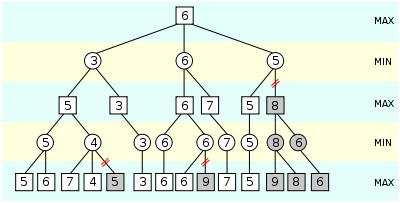
Alpha-beta-pruning
An illustration of alpha-beta pruning. The grayed-out subtrees need not be explored (when moves are evaluated from left to right), since we know the group of subtrees as a whole yields the value of an equivalent subtree or worse, and as such cannot influence the final result.

This allows for a much more efficient process and allows an average look-ahead of 10 or so forth-coming actions to be computed in the average recorded Marshal Cadet reaction time of 175 milliseconds. Assuming your expertise, you might hope to shave some of that off, but the threat still remains – are you up to the challenge of an opponent who is constantly acting from the future?

I’ll be installing this momentarily after my research report is submitted back to the CoRe Technology DB, I encourage you all to help with my research in it. I’m certain I’ll be able to create far stronger simulations based off data I can gather from its performance against a wide variety of strengths and weaknesses, and I believe its fundamental properties will enforce a stronger discipline from everyone, myself included, by pointing out the weakness of rash or uneducated assumptions within the immediate flow of battle.

-Crono Arinborn

Filed under: Simulation Manipulations | Posted on February 24th, 2009 by Crono | 1 Comment »

Categories

Archive

Links

Meta

Copyright © 2025 CoRe Technology Initiative. All rights reserved.

Tech Blue designed by Hive Designs • Ported by Free WordPress Themes and Online Marketing